
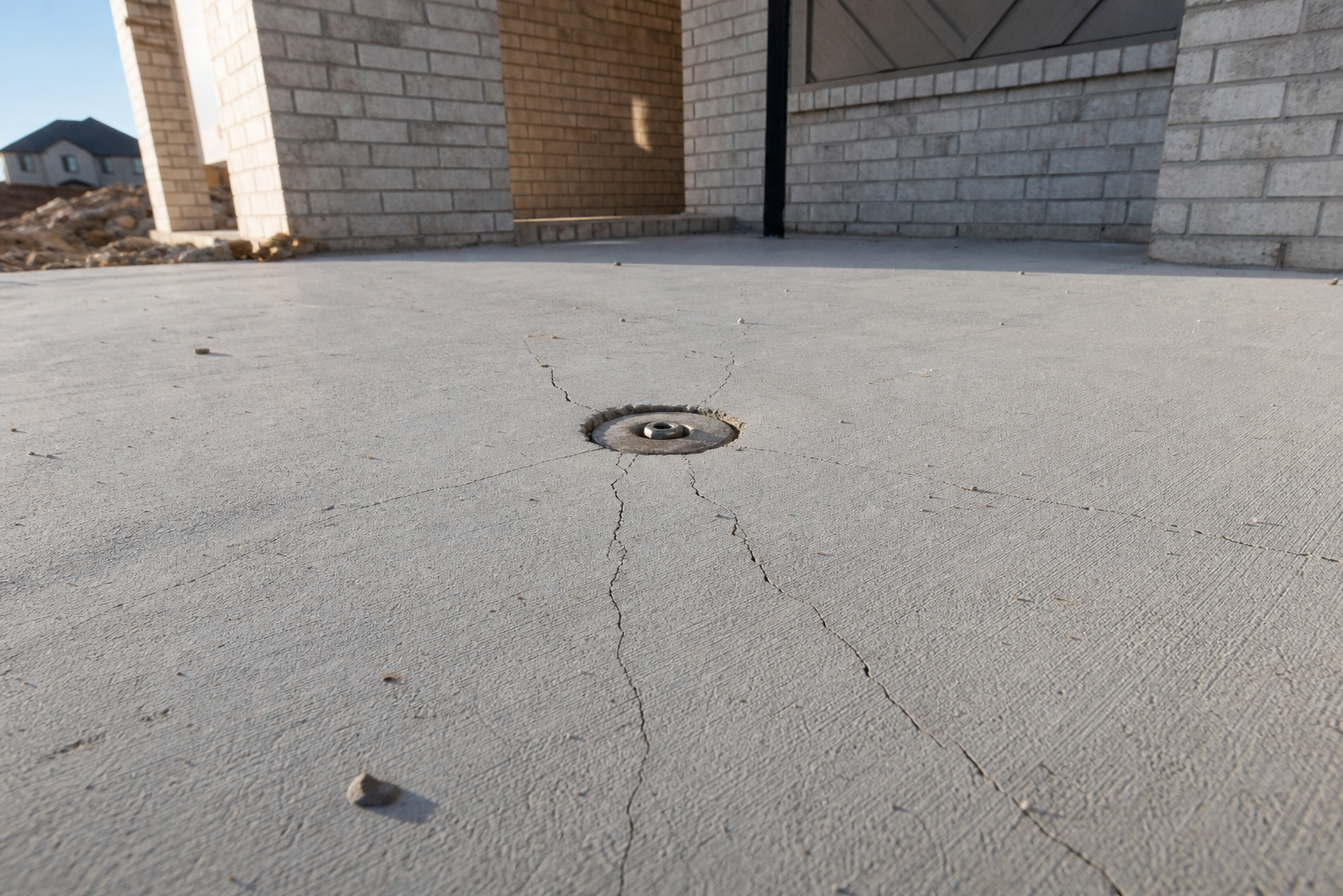
Post-Tension Slab Problems in North Texas New Builds
You bought a brand-new home in Frisco, McKinney, or Celina. Everything was pristine — fresh paint, untouched countertops, that new-house smell. Fast forward three to seven years, and you’re staring at cracks in your tile, gaps between the wall and crown molding, and a door that won’t close without a firm shove. How is this possible in a house that’s barely out of its builder warranty?
The answer often lies beneath your feet: your post-tension slab foundation. And if you own a home built in the DFW metroplex after roughly 2000, there’s an excellent chance you’re standing on one right now.
What Is a Post-Tension Slab?
A post-tension slab is a type of concrete foundation reinforced with high-strength steel cables (called tendons) that run through the concrete in a grid pattern. After the concrete cures, these cables are pulled tight — tensioned — using hydraulic jacks and locked in place at anchor points along the foundation’s edge. The tension in the cables compresses the concrete, making it more resistant to cracking and allowing builders to use thinner slabs over expansive soils.
In theory, it’s an elegant engineering solution. The compressed concrete can flex and bridge over minor soil voids without fracturing. For a region like North Texas, where Blackland Prairie clay expands and contracts with every rain cycle, post-tension slabs offered builders a way to construct foundations faster and more affordably than traditional rebar-reinforced slabs with deep pier supports.
Why DFW Builders Rely on Post-Tension Slabs
Dallas-Fort Worth has been the number-one new construction market in the United States for years. Builders are putting up thousands of homes annually across master-planned communities stretching from Frisco and Prosper in the north to Midlothian and Waxahachie in the south.
Post-tension slabs became the standard in DFW new construction for practical reasons. They require less concrete than traditional foundations, can be poured and stressed quickly to keep pace with aggressive construction timelines, and they perform reasonably well on moderately expansive soils when everything goes right.
The emphasis is on “when everything goes right.” Because increasingly, foundation professionals across North Texas are seeing post-tension slabs that aren’t performing as advertised — sometimes within just a few years of construction.
Common Post-Tension Slab Problems in DFW
Cable Corrosion and Tendon Deterioration
The steel tendons inside your post-tension slab are the foundation’s structural backbone. They’re supposed to be protected by the surrounding concrete and, in most modern construction, a plastic sheathing and anti-corrosion grease. But protection isn’t always perfect.
In the DFW environment, several factors accelerate corrosion. Soil moisture fluctuations can introduce water vapor to the concrete matrix. Poor drainage that allows standing water against the foundation edge exposes anchor points to moisture. And if the concrete itself has micro-cracks — common after the first few drought-swell cycles — water can migrate to the tendons.
Corroded tendons lose tensile strength. In severe cases, a tendon can snap entirely. When that happens, you may hear a loud bang — homeowners often describe it as sounding like a gunshot inside the walls. A broken tendon means that section of the slab loses its compressive reinforcement, and cracking typically follows.
Anchor Failures at the Foundation Edge
Each tendon terminates at an anchor point — a metal fitting embedded in the concrete at the slab perimeter. These anchors hold the cable tension in place. If an anchor was improperly set during construction, or if the concrete around it deteriorates, the anchor can slip or fail.
Anchor failures are particularly concerning because they tend to occur at the foundation’s edge, which is already the most vulnerable zone for soil movement in North Texas. When an edge anchor releases, the tendon goes slack and an entire line of reinforcement is effectively lost.
In newer DFW communities where homes are built close together on compact lots, the foundation edges also receive less sun exposure on certain sides, creating uneven drying patterns that stress anchor zones differently.
Cracking Despite the Cables
One of the biggest misconceptions about post-tension slabs is that they don’t crack. They absolutely can and do. The post-tensioning system is designed to minimize cracking under expected conditions, but North Texas soil movement often exceeds those design assumptions.
Builders design post-tension slabs based on a geotechnical report for the specific lot. That report estimates the soil’s potential vertical rise (PVR) — how much the soil might expand. But if the PVR was underestimated, or if conditions change after construction (a new drainage pattern, removal of nearby vegetation, an extended drought worse than historical norms), the slab can experience forces beyond its design capacity.
When that happens, you see classic foundation damage: cracks radiating through the slab, tile popping loose, drywall separating at seams, and uneven floors. The frustrating part for homeowners is that these symptoms can look identical to traditional slab failure, even though the underlying structure is fundamentally different.
Inadequate Soil Preparation
Speed is the enemy of quality in high-volume residential construction. Some DFW builders have been cited for inadequate soil preparation before pouring post-tension slabs. This can include insufficient moisture conditioning of the subgrade, improper compaction, or failure to remove organic material from the building pad.
When the soil beneath the slab wasn’t properly prepared, no amount of post-tensioning can compensate. The foundation will move with the poorly prepared subgrade, and problems typically emerge within the first three to five years.
The 3-to-10-Year Problem Window
Foundation professionals in North Texas have identified a pattern: post-tension slab problems in DFW new builds tend to surface between three and ten years after construction. Here’s why that window matters:
- Years 1-2: The slab is still settling into equilibrium with the underlying soil. Minor cosmetic cracks are common and often within builder warranty tolerances.
- Years 3-5: The foundation has now been through several full drought-swell cycles. Cumulative soil movement begins to exceed the slab’s designed flexibility. Early structural cracks and functional problems (sticking doors, tile damage) appear.
- Years 5-10: Corrosion processes that started at construction have had time to weaken tendons. Anchor points have endured years of edge exposure. Original landscaping has matured, with tree roots pulling moisture from the soil. This is when many homeowners in McKinney, Plano, and surrounding communities first realize they have a foundation problem.
The timing is significant because most builder structural warranties in Texas last ten years. But by the time symptoms become undeniable, the warranty period may be close to expiring — or the builder may dispute that the damage qualifies.
Your Rights Under the Texas RCLA
The Texas Residential Construction Liability Act (RCLA) governs disputes between homeowners and builders over construction defects, including foundation problems. If you believe your post-tension slab has a defect related to construction quality, the RCLA establishes a specific process:
You must provide your builder with written notice of the claimed defect at least 60 days before filing a lawsuit. The builder then has 35 days to inspect the property and 45 days from receiving notice to make a written offer to repair, settle, or dispute the claim.
This process exists to encourage resolution without litigation, but it also means you need documentation. Having a professional foundation inspection that identifies specific deficiencies — not just “there are cracks” but measurable deflection, identified causes, and a professional opinion on whether the damage exceeds normal tolerances — strengthens your position considerably.
Important note: the RCLA has strict timelines. Consulting with both a foundation professional and an attorney experienced in Texas construction law early in the process protects your options.
When to Get a Structural Assessment
If your DFW home is built on a post-tension slab and you’re experiencing any of the following, it’s time to have the foundation evaluated:
- Cracks in tile or concrete floors that appear to follow a linear pattern (this can indicate a crack running along or across a tendon line)
- A loud snap or bang from within the slab — a possible tendon failure
- Doors or windows that worked fine at move-in but now stick or won’t latch
- Visible cracks in the exterior slab edge near anchor pocket locations
- Uneven floors that have developed gradually over several years
- Separation between walls and ceilings or walls and floors
A qualified foundation inspector will evaluate your slab’s current condition, measure elevation differentials across the floor plan, and identify whether the issues are cosmetic, functional, or structural. For post-tension slabs specifically, it’s critical that the inspector understands PT construction — the repair approach for a post-tension slab differs fundamentally from a conventionally reinforced slab.
Repair Considerations for Post-Tension Slabs
Repairing a post-tension slab requires specific expertise because of the high-tension cables running through the concrete. You cannot simply core through the slab to install interior piers without first locating every tendon — striking a tensioned cable during drilling is extremely dangerous and can cause catastrophic damage to the slab.
Experienced foundation repair companies in the DFW market use ground-penetrating radar or the original post-tension drawings (if available from the builder) to map tendon locations before planning any repair work. Exterior pressed pilings or helical piers along the foundation perimeter are often the preferred approach, as they avoid the tendon field entirely.
Slab repair on post-tension foundations is absolutely possible and is performed regularly across North Texas. The key is working with a company that has specific experience with PT slabs — not every foundation repair contractor does.
Frequently Asked Questions
Can a post-tension slab be repaired, or does the whole foundation need replacement?
Post-tension slabs can be repaired in the vast majority of cases. Foundation repair typically involves installing support piers around the perimeter or in specific locations to stabilize and, where possible, lift the slab back toward its original elevation. Full foundation replacement is extremely rare and only considered in cases of catastrophic failure.
My home is only five years old and has foundation cracks. Is that normal for DFW?
Minor hairline cracks can occur in any new slab as it cures and adjusts to the underlying soil. However, cracks that grow over time, cracks accompanied by functional issues like sticking doors, or cracks wider than a credit card’s thickness are not normal and warrant professional evaluation — regardless of your home’s age.
How do I know if my home has a post-tension slab?
Most homes built in the DFW metroplex after approximately 2000 have post-tension slabs. You can check your original construction documents, look for small circular “dimples” or plugged holes along the slab edge (these are tendon anchor pockets), or ask your builder. A foundation professional can also confirm the slab type during an inspection.
Will my builder cover post-tension slab repairs under warranty?
Texas builder warranties vary by company, but most include a ten-year structural warranty. Whether specific damage qualifies depends on the warranty terms and whether the builder determines it to be a construction defect versus normal soil-related movement. Having an independent foundation assessment gives you objective documentation if a dispute arises.
Is there anything I can do to prevent post-tension slab problems?
Maintaining consistent moisture around your foundation is the most effective preventive step. Use soaker hoses during drought, ensure proper drainage during heavy rain, and address any plumbing leaks promptly. Consistent moisture reduces the severity of soil expansion and contraction that stresses even well-built post-tension slabs.
Own a newer DFW home with foundation concerns? Post-tension slab issues don’t fix themselves, and waiting can complicate both repairs and warranty claims. Call Level Home Foundation Repair at 972-217-4820 for a free foundation inspection — we understand PT slab construction inside and out.
Leave a Reply