
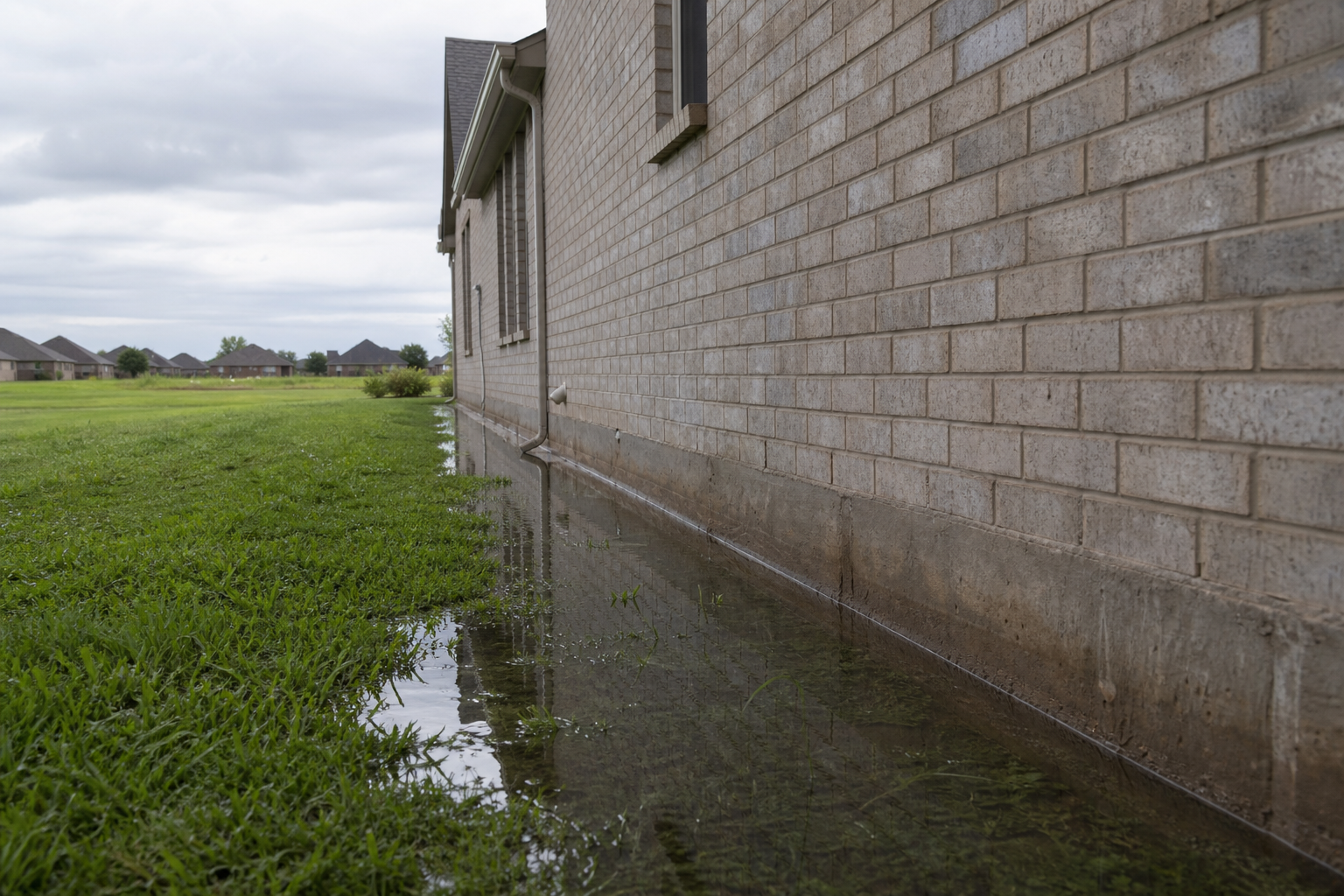
Drainage Solutions for Flat North Texas Lots
If you own a home in the Dallas-Fort Worth metroplex, you’ve probably noticed something about your yard after a heavy rainstorm: the water just sits there. Unlike regions with rolling hills and natural drainage corridors, most of the DFW landscape is remarkably flat. The Blackland Prairie that stretches across North Texas was shaped by ancient seas, not mountain runoff, and the result is terrain that offers water very few places to go.
That standing water isn’t just an inconvenience. For the tens of thousands of homes built on North Texas expansive clay soils, pooling water is one of the most common — and most preventable — causes of serious foundation damage. The good news is that effective drainage solutions for flat lot properties in North Texas exist for every budget and every property type. This guide walks you through the options, the science behind why drainage matters so much here, and how to decide which approach is right for your home.
Why Flat Lots Are the Norm in DFW
Drive through communities like Flower Mound, Lewisville, Rowlett, or virtually any suburb in the metroplex, and you’ll see lot after lot that is essentially level. Builders love flat terrain — it’s cheaper to grade, easier to pour slab foundations on, and allows for denser development. That’s a big reason DFW has become the number-one new construction market in the country.
But flat lots present a fundamental problem: water needs gravity to move, and when there’s nowhere for it to flow, it accumulates. In neighborhoods with heavy clay soil — which describes most of the Blackland Prairie — that water can’t even percolate downward efficiently. Clay acts like a sponge that’s already saturated, holding moisture at the surface for days or even weeks after a storm.
North Texas receives between 35 and 40 inches of rainfall in a typical year. That might not sound extreme, but consider how it arrives: the DFW area is notorious for intense, concentrated downpours. A single spring thunderstorm can dump two or three inches in under an hour. When that volume of water lands on a flat lot with clay soil and no drainage system, it has no choice but to pool against your home’s foundation.
How Standing Water Destroys Foundations Over Time
To understand why drainage matters so much in DFW, you need to understand what happens beneath the surface. The Blackland Prairie clay that underlies most of the metroplex is classified as “expansive soil.” When it absorbs moisture, it swells — sometimes dramatically. When it dries out during our brutal summer heat, it shrinks and cracks.
This seasonal expansion-and-contraction cycle is the number-one driver of foundation damage across North Texas. Standing water on a flat lot amplifies this problem in two critical ways:
Uneven moisture distribution. When water pools on one side of your home but not the other, the soil beneath that side expands while the opposite side remains dry and contracted. This differential movement pushes your foundation unevenly, leading to cracks, sticking doors, and sloping floors.
Prolonged saturation periods. On a flat lot without drainage, water may sit against your foundation for days after a rain event. The longer water stays in contact with the slab perimeter, the deeper moisture penetrates into the clay. When the summer heat finally arrives and dries things out, the soil rebound is more severe, causing greater vertical movement.
Over months and years, this repeated wet-dry cycling gradually shifts and cracks even well-built foundations. Homeowners in areas like Rowlett and Lewisville frequently report that their first signs of foundation distress appeared within a few years of a particularly wet season followed by a drought summer.
Drainage Solutions That Work on Flat DFW Properties
Every flat lot is different, and the right drainage strategy depends on your soil composition, lot size, the location of your home on the lot, existing landscaping, and where water tends to collect. Here are the most effective options for North Texas properties.
French Drains
French drains are the workhorse of residential drainage in DFW. A French drain is a trench filled with gravel and fitted with a perforated pipe that collects subsurface water and channels it to a discharge point — typically the street, an alley, or a dry well.
For flat lots, French drains are especially valuable because they intercept water that’s moving laterally through the soil before it reaches your foundation. They’re typically installed around the perimeter of the home or along the uphill side of the property (even a slight grade of a few inches matters). In areas like Flower Mound, where newer developments sit on compacted fill, French drains are frequently the first recommendation for homeowners noticing persistent dampness near the slab.
Surface Drains and Catch Basins
Surface drains — sometimes called area drains or catch basins — are grated inlets installed at low points in your yard where water visibly collects. They connect to underground PVC pipe that carries water to a discharge location.
On flat lots, surface drains are ideal for addressing specific problem areas: the corner of the yard where water always stands after a storm, the low spot near the patio, or the area between your home and your neighbor’s fence. They’re straightforward, relatively affordable, and can be combined with French drains for comprehensive protection.
Channel Drains
Channel drains (also called trench drains or linear drains) are narrow, elongated drains set into concrete surfaces like driveways, patios, or walkways. They’re designed to intercept sheet flow — the thin layer of water that runs across hard surfaces during rain.
In DFW, channel drains are commonly installed where a driveway meets a garage or where a patio slopes toward the home. On flat lots, even a subtle backward slope on a driveway can funnel enormous volumes of water toward the foundation. A channel drain across the driveway’s width catches that flow before it becomes a foundation problem.
Grading Corrections
Sometimes the simplest solution is the most effective. Proper grading ensures that the ground around your home slopes away from the foundation at a minimum pitch — typically six inches of drop over the first ten feet. On many flat DFW lots, this grade either was never established properly during construction or has eroded and settled over time.
Regrading involves adding or redistributing soil to create a gentle slope away from the home on all sides. It’s particularly important in newer DFW subdivisions where builders may have left minimal clearance between the slab edge and the surrounding grade. A professional assessment can identify whether your lot’s current grading is contributing to water accumulation near the foundation.
Sump Pumps
In situations where gravity alone can’t move water to an appropriate discharge point, sump pumps provide mechanical assistance. A sump pump sits in a collection pit (the sump) and activates automatically when water reaches a certain level, pumping it away from the home through a discharge line.
Sump pumps are less common in DFW than in regions with high water tables, but they’re invaluable for specific scenarios on flat lots: interior crawl spaces in older pier-and-beam homes, basements (rare but present in some older Dallas neighborhoods), and properties where the discharge point is at a higher elevation than the collection area.
Signs Your Flat Lot Needs Better Drainage
Not sure whether your property has a drainage problem? Watch for these indicators, which are particularly common on flat North Texas lots:
- Water pooling within five feet of your foundation after rainstorms that lasts more than 24 hours
- Mud or erosion patterns near the slab edge, especially where soil has washed away from the foundation
- Lush, green patches of grass near the foundation while the rest of the yard is dry — a sign of persistent subsurface moisture
- Efflorescence (white mineral deposits) on the exterior of your slab, indicating moisture is wicking through the concrete
- Interior signs of foundation movement: sticky doors, cracked drywall, or gaps between walls and ceilings that seem to worsen after rainy periods
If you’re seeing any combination of these signs, the connection between poor drainage and foundation stress is likely already underway.
Drainage and Foundation Repair: A Paired Approach
At Level Home Foundation Repair, we frequently encounter DFW homeowners who have invested in foundation repair but haven’t addressed the drainage issues that caused the damage in the first place. Repairing a foundation without fixing the underlying moisture problem is like patching a roof leak without fixing the hole — the symptoms will return.
That’s why we evaluate drainage as part of every foundation inspection. If your flat lot is directing water toward the home rather than away from it, we’ll identify the contributing factors and recommend drainage improvements that protect your repair investment for the long term.
This paired approach is especially important in communities like Lewisville and Rowlett, where rapid development on flat terrain has created entire neighborhoods where drainage planning during construction didn’t anticipate how the clay soils would behave over time.
Seasonal Considerations for DFW Drainage
North Texas weather creates a unique drainage challenge because of its extremes. The wet seasons — typically spring and fall — bring heavy, concentrated rainfall that overwhelms flat lots. Then summer arrives with 100-degree temperatures and weeks without rain, causing the clay to dry, crack, and pull away from foundations.
The ideal time to install or upgrade your drainage system is during the drier months, when trenching is easier and you can prepare your property before the next wet season arrives. However, if you’re seeing active water pooling against your foundation during a rainy stretch, don’t wait — even temporary measures like extending downspouts and adding splash blocks can reduce immediate risk while you plan a permanent solution.
Frequently Asked Questions
How much do drainage solutions cost for a flat lot in DFW?
Costs vary widely depending on the type and scope of work. Basic French drain installations for residential properties in the Dallas-Fort Worth area typically range from a few thousand dollars for a single run along one side of the home to significantly more for comprehensive perimeter systems. Surface drains and catch basins are generally among the most affordable options. A professional evaluation of your specific lot is the best way to get an accurate estimate.
Can I install French drains myself on my flat North Texas lot?
While DIY French drain installation is possible, North Texas clay soil presents challenges that make professional installation advisable. The clay is extremely difficult to trench through when dry and becomes a slippery, sticky mess when wet. Proper pipe pitch is critical on flat lots — even a slight miscalculation can create a system that doesn’t drain. Professional installation also ensures proper discharge that complies with local municipal codes in cities like Flower Mound and Lewisville.
Will improving drainage alone fix my foundation problems?
Drainage improvement is essential for preventing future foundation damage, but it typically won’t reverse damage that has already occurred. If your foundation has already shifted or cracked due to moisture-related soil movement, you’ll likely need foundation repair in addition to drainage correction. The drainage work ensures the repair holds and new damage doesn’t develop.
Does homeowners insurance cover drainage installation in Texas?
Standard homeowners insurance policies in Texas generally do not cover drainage system installation, as it’s considered a maintenance and prevention measure rather than repair of sudden damage. However, some policies may cover damage caused by sudden water events. Check with your insurance provider for specifics about your policy.
How do I know which drainage solution is right for my flat lot?
The best approach depends on where water is collecting, how your lot is graded, what type of soil you have, and where water can be discharged. A professional drainage assessment evaluates all of these factors and recommends a solution — or combination of solutions — tailored to your property. Many DFW properties benefit from a combination of French drains, surface drains, and grading corrections working together.
Protect Your North Texas Home from Water Damage
On the flat terrain of the Dallas-Fort Worth metroplex, water won’t move away from your foundation on its own. It needs help — and the right drainage system provides exactly that. Whether you’re dealing with visible pooling, unexplained foundation cracks, or simply want to protect your investment before problems start, addressing drainage is one of the smartest moves a DFW homeowner can make.
Call Level Home Foundation Repair at 972-217-4820 for a free foundation and drainage evaluation. We’ll assess your flat lot, identify where water is causing trouble, and recommend solutions that keep your foundation stable through every North Texas weather cycle.
Leave a Reply